
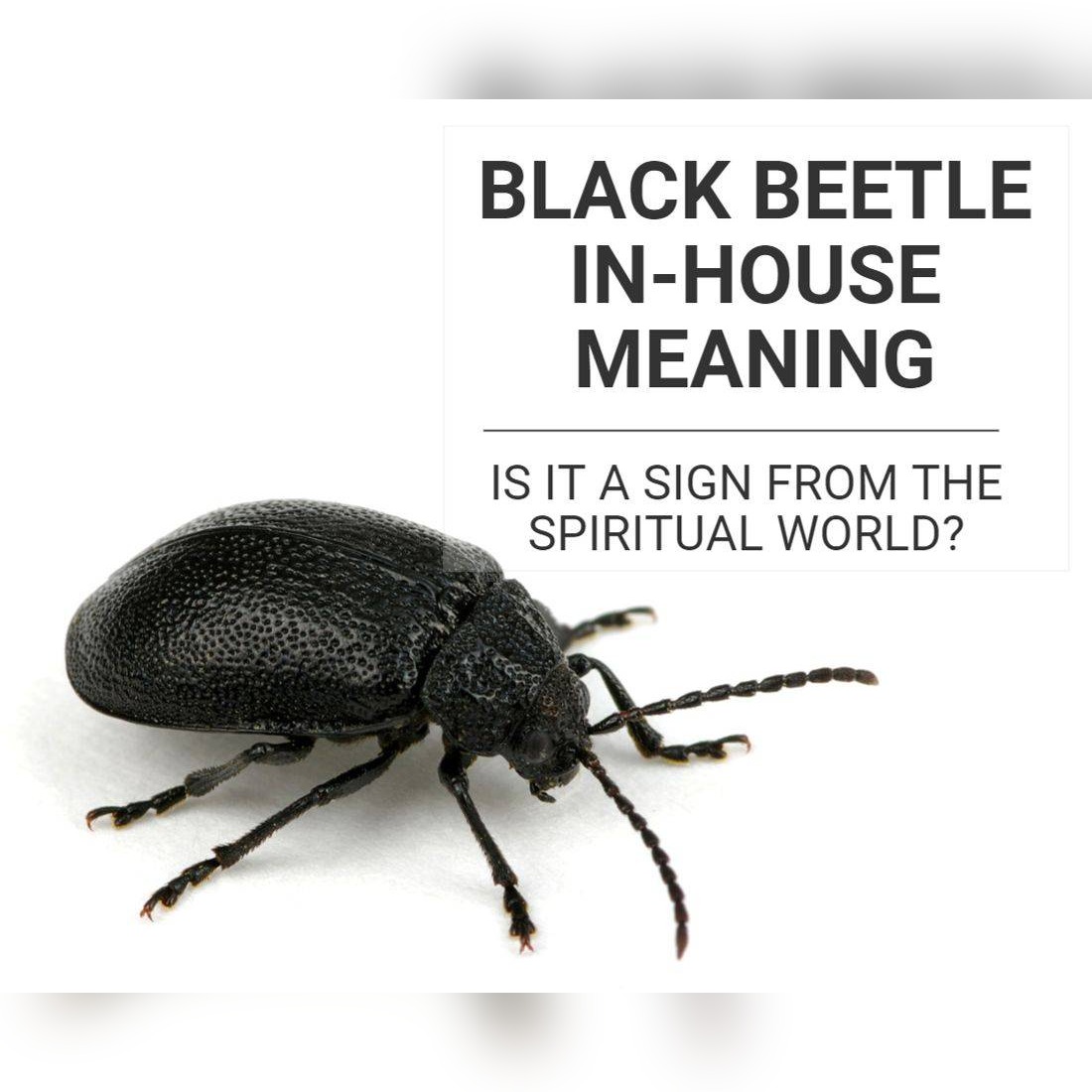
A black beetle on your bedroom floor, or crawling up the bathroom wall, stops you mid-step. In ancient Egypt, the scarab meant rebirth and protection, carved into amulets for the dead. But German folklore saw the black stag beetle as a house burner, a sign of fire and danger, and which one applies depends on what kind of beetle you’re looking at.
Key Takeaways
- No single tradition owns the black beetle. The Egyptian reading is protective; the German reading is a fire omen. Both are documented. Neither is made up.
- The most grounded Egyptian evidence comes from funerary and royal contexts, not household visits. The scarab-in-your-kitchen reading is a modern extrapolation from a genuine ancient belief.
- Grimm’s Deutsche Mythologie (1835) records the stag beetle’s German names directly: Feuerschroter, fire spreader; Hausbrenner, house burner. The fear was real and specific.
- Nahua material from the Codex Florentino read indoor insects as potentially sent by a hostile party, not as neutral wanderers.
- Species matters before symbolism. A large glossy ground beetle wandering in under your back door is a different creature, practically and otherwise, from a carpet beetle living in your walls.
What Does It Mean When a Black Beetle Enters Your House?
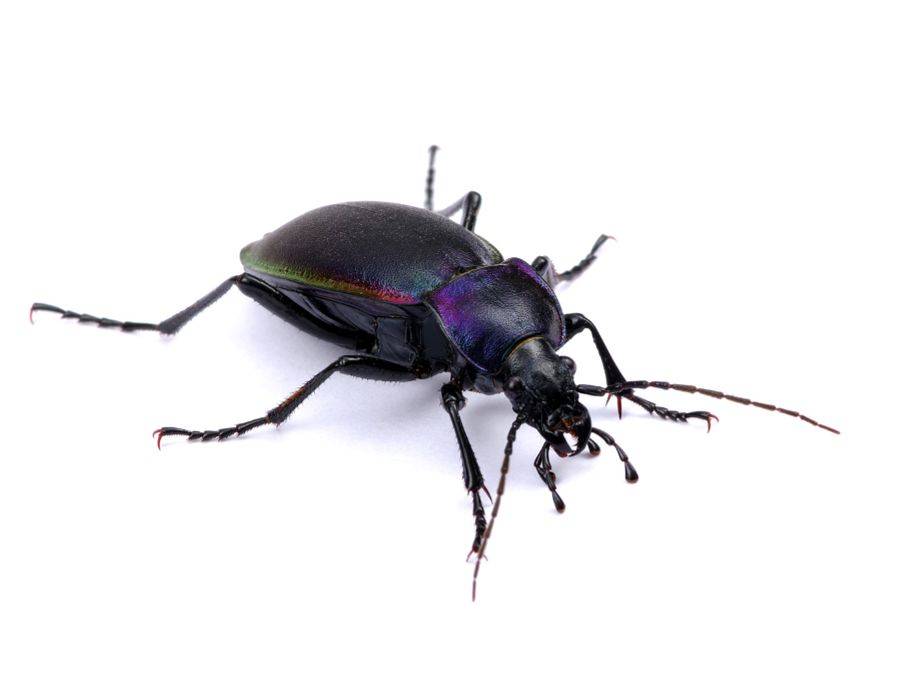
There is no single answer, and I want to say that plainly before anything else, because you deserve it upfront. A large ground beetle that pushed through a gap under your back door is a different animal from the small, rounded carpet beetle that entomological research identifies as Anthrenus or Attagenus species, the ones that live in your walls and feed on natural fibers year-round. Species matters. It matters practically, and it matters symbolically, because every tradition that recorded beetle omens was talking about a specific creature they could see and name.
My grandmother Theresa kept a leather notebook of animal lore from the Bavarian Forest, handwritten in the 1920s in a German cursive I can still only partly read. There is an entry in it that names a dark ground beetle in the context of a household that later suffered a barn fire. I have never been sure whether she was recording a folk belief or simply narrating a coincidence. That ambiguity is probably the honest thing to carry into what follows.
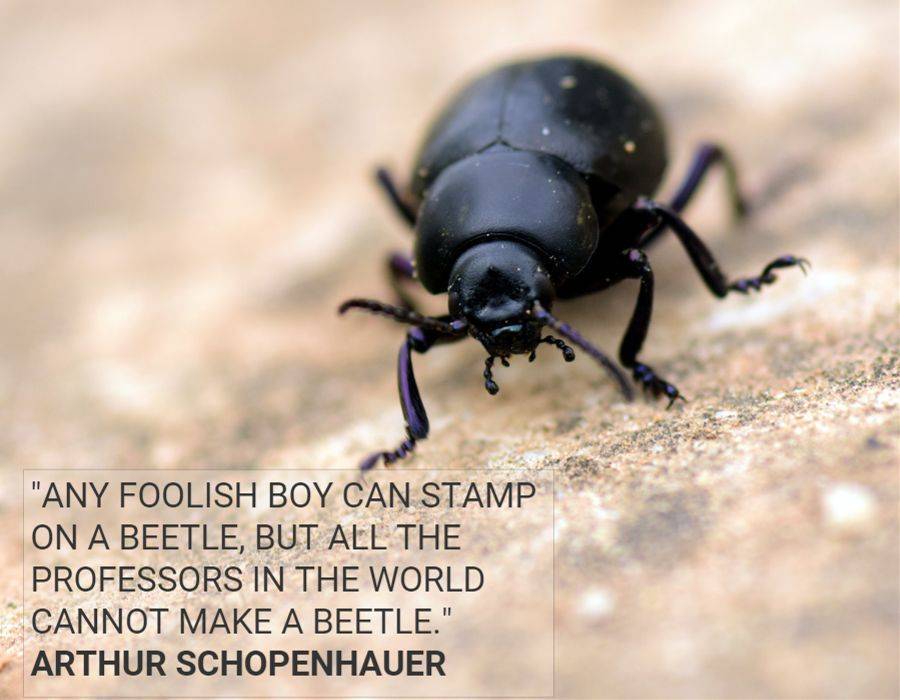
You noticed this beetle. That is already part of the answer. The people who asked this question before you were not foolish, and the traditions they carried were not random.
Is a Black Beetle in the House a Good Omen or a Bad One?
Both readings exist, and the record supports both. The good reading goes back to ancient Egyptian solar religion, where the scarab beetle, specifically Scarabaeus sacer, the dung beetle, was one of the most important sacred animals in the tradition. The Egyptians watched this beetle roll a ball of dung across the ground and recognized in it an image of the sun god Khepri pushing the solar disc across the sky. The hieroglyph kh-p-r, shaped like the beetle, meant “to come into being,” “to exist,” “to grow.” Scarab amulets were placed on the chests of the dead, worn by the living, and documented extensively in Egyptological research at institutions including Johns Hopkins University. Protection. Renewal. Continuation.
The bad reading comes from German-speaking Europe. The stag beetle’s regional German names explain the fear directly: Feuerschroter means fire spreader; Hausbrenner means house burner. The belief, recorded in Grimm’s Deutsche Mythologie in 1835, was that large black beetles carried burning embers to thatched roofs. A beetle crossing the threshold was associated with domestic fire.
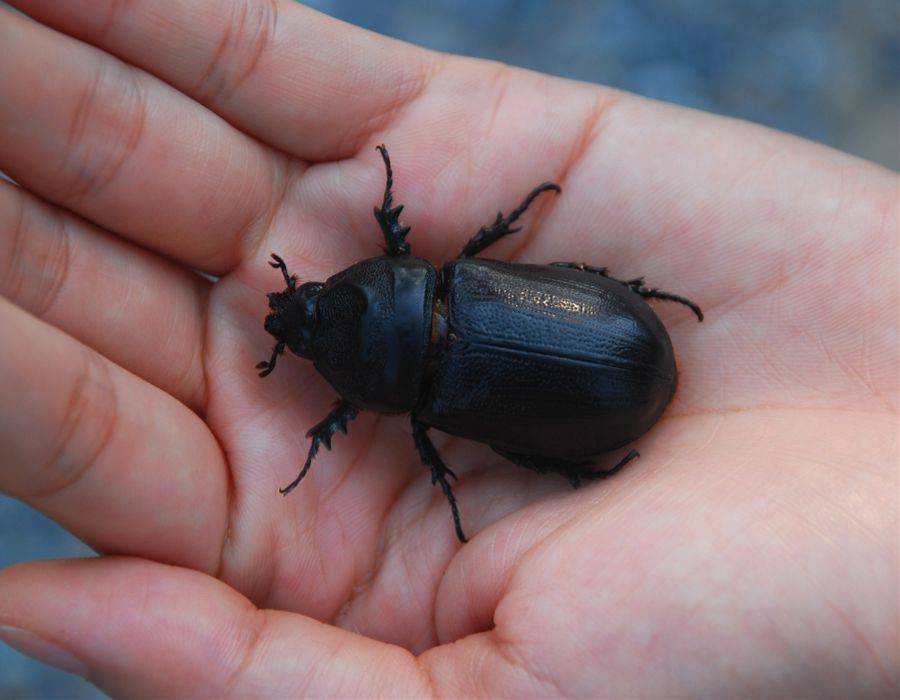
Protective rebirth or fire omen. The tradition you grew up nearest to, or the one that fits the beetle you actually found, will determine which reading holds.
What Do Different Cultural Traditions Say About Beetles Inside the Home?
Four traditions have documented this encounter in enough detail to take seriously. None of them is talking about a generic black beetle. Each is talking about a specific insect inside a specific social world.
Ancient Egyptian tradition. The scarab’s household role came through amulets and jewelry, not spontaneous appearances. When a household kept a scarab image, it was a deliberate protective object. The Egyptian symbolic architecture was there, rebirth, protection, Khepri, but it operated in ritual and funerary contexts. Whether a live dung beetle wandering into your kitchen was treated as a direct omen is not clearly established in the surviving texts.
German rural folklore, 19th century. According to Grimm’s Deutsche Mythologie and the beetle folklore survey compiled by scholar Cor Hendriks, a jet-black beetle appearing indoors was considered unlucky in several regional accounts, and the prescribed response was to throw it into the fire rather than release it. The fire association ran both directions: the beetle was thought to bring fire, and fire was used to deal with it.
Nahua tradition, Codex Florentino. Material from the Codex Florentino describes indoor insects, particularly ants, as bad omens when they appeared inside the house uninvited. Their presence could indicate that an enemy had magically sent them. Beyond ants, a mid-20th-century entomological compilation recorded an Aztec divination practice using a chafer-type beetle: the beetle was placed at the center of a cross drawn on the ground, and its direction of movement predicted whether a sick person would recover. A beetle moving north meant death; other directions meant survival. This is controlled ritual use, not a casual household encounter, but it shows beetles as deliberate interpretive tools.
Japanese mushi folk religion. In Japanese folk belief, insects occupy a category of small living things with their own spiritual character. The concept of mushi no shirase, a signal or message carried by an insect, does appear in folk accounts. I am less confident about the beetle-specific documentation here than I am about the Egyptian or German material. The Japanese record tends toward crickets and fireflies. I don’t want to overstate what I know.
What Does the Ancient Egyptian Scarab Tradition Actually Say About Beetles in the Home?
Here I have to be straight about an extrapolation that gets made constantly. The Egyptian scarab is one of the most documented animal symbols in human history. The kh-p-r hieroglyph. The thousands of scarab amulets in museum collections worldwide. The funerary texts placing the heart scarab on the chest of the dead so that the heart would not testify against its owner at judgment. The winged scarab as a ward against evil. All of this is real, all documented, all traceable.
But the step from “ancient Egyptians revered the scarab as a symbol of rebirth” to “a black beetle in your modern kitchen is an Egyptian rebirth omen” is an interpretive leap, not a documented fact. Egyptian texts are overwhelmingly concerned with the scarab in funerary, solar, and royal contexts. The spontaneous appearance of a dung beetle in a household was not the subject of systematic Egyptian omen literature the way certain bird behaviors were tracked in Mesopotamian omen texts. So when you read that a black beetle in your house carries “Egyptian rebirth energy,” that reading is downstream from a genuine ancient belief. But it is not itself an ancient Egyptian folk tradition about household beetles.
Where in the House Does the Beetle Appear, and Does Location Change the Meaning?
In the basement or crawl space. Practically speaking, the University of Kentucky entomology department’s household beetle guide notes that many beetles found in basements, ground beetles, click beetles, certain darkling beetles, enter through foundation cracks in search of moisture and shelter, especially in autumn. A beetle in the basement is frequently a practical matter of weatherization. I think it is worth checking both explanations.
What Should You Do After Finding a Black Beetle in Your House?
First, identify it. This matters as much as the symbolism, maybe more. The University of Florida IFAS extension guide to household beetles is a good starting point. Large and glossy with long legs? Probably a ground beetle, a temporary visitor. Small, rounded, covered in fine hairs or scales? Possibly a carpet beetle, which is a different problem and one that benefits from practical action.
Frequently Asked Questions
Are black beetles in the house dangerous or harmful?
Most large black beetles that wander indoors, ground beetles, click beetles, darkling beetles, don’t bite under normal circumstances, don’t carry disease, and aren’t interested in your food or clothing. Carpet beetles are the exception: small, rounded, sometimes black or mottled, they feed on wool, feathers, and dried animal products. If you’re finding damage to stored natural-fiber items, identification matters practically. A single large beetle crossing your floor is almost always just lost, looking for a way back out.
What does it mean if a black beetle lands on you inside your home?
In the Egyptian amulet tradition, physical contact with a scarab image was the point: the beetle’s presence on the body was protective. A live beetle landing on you follows a similar symbolic logic, contact rather than distance implies a more direct encounter. The German fire-omen reading focused on beetles entering the living space, not landing on people specifically, so that tradition fits less naturally here. You are not in danger. Ground beetles land on warm surfaces, and you are a warm surface.
Is a black beetle in the house a sign of death?
No tradition I’ve found makes this claim directly about beetles. The death associations in European insect folklore cluster around certain moths and the deathwatch beetle, a wood-boring species that makes a ticking sound in old timber and was associated with the countdown to death. The German black-beetle tradition is about fire and misfortune, not death specifically. The Egyptian tradition is the opposite of a death sign. If you found this beetle on a hard day, I understand the connection your mind is making. But the documented record doesn’t support it.
What does it mean if you keep seeing black beetles repeatedly in your house?
Practically: a recurring beetle presence usually means a consistent entry point or food source. Ground beetles are drawn to moisture and light. Carpet beetles are drawn to natural fibers and pet hair. Before reaching for a symbolic reading of repetition, check foundation gaps, window seals, and any stored wool. If the practical explanation doesn’t hold, the question of pattern becomes more interesting. Nahua tradition, per the Codex Florentino material, read recurring insect appearances as more charged than single encounters. I don’t have a confident answer beyond that. The folk record is thin here.
Does killing a black beetle in the house bring bad luck?
The German tradition actually prescribed throwing indoor black beetles into the fire, so that tradition did not associate killing them with subsequent misfortune. In some European folk beliefs, killing certain beetles, particularly stag beetles, was forbidden because of their association with thunder gods. But for the general indoor black beetle, I haven’t found a documented tradition that treats killing it as the cause of later bad luck. The Nahua view of indoor insects as potentially sent by hostile magic would suggest removal is appropriate, not preservation.
What is the difference in meaning between a black beetle and a brown or red beetle indoors?
Color coding in beetle symbolism is not as systematic as it is in butterfly symbolism, where yellow versus black versus white carries fairly consistent traditional weight across cultures. The German fire-omen attached specifically to large, dark beetles. The Egyptian scarab is naturally dark, almost black. But a brown or red beetle indoors doesn’t have a strongly documented separate omen tradition, at least not one I trust. I’d say species matters more than color here. Identify the beetle first, then look for the tradition that speaks to that specific creature.
Can a black beetle in the house be a sign from a deceased loved one?
I don’t believe animals are literal messengers from the dead, and I say that as someone who has spent years watching what grief does to attention. What I do believe is that when we’re missing someone, we reach for signs, and an unexpected animal in an unexpected place can hold that reaching in a way that feels real. Whether the beetle is a message or a mirror of your grief, I’m not sure the distinction matters as much as what you do with the encounter. The Egyptian tradition made the beetle a symbol of continuation after death. That is not nothing.
What does it mean spiritually if a black beetle appears in your bedroom specifically?
The bedroom carries its own weight, the most private room, the place of sleep and vulnerability, but I haven’t found a documented tradition that assigns a specifically different meaning to a bedroom beetle versus a kitchen beetle. People tend to find bedroom encounters more unsettling, and that’s about the room’s intimacy, not the beetle’s intention. If the fire-omen tradition speaks to you, the bedroom is not a hearth-adjacent space, so that reading fits less naturally there. The protective reading from Egyptian belief doesn’t shift much by location; the symbol is the creature, not the room.
Sources
- Entomology Journals, Household Beetle Species Identification (2020)
- University of Kentucky Entomology Department, Beetles in the Home
- University of Florida IFAS Extension, Household Beetle Guide
- Johns Hopkins Archaeological Museum, Ancient Egyptian Scarab Amulets
- Cor Hendriks, The Folklore of the Ladybird (includes broader beetle folklore survey)
- Kusami.com, The Stag Beetle in European Folklore (2017)
- Animals and Society Institute, Laurent, “Definition and Cultural Representation of the Mushi Category in Japan”
- Wikipedia, Scarab (artifact), Egyptian solar and funerary context
- Britannica, Scarab beetle in ancient Egyptian religion






I had a beetle under my pillow
First time I have ever seen one
What does this mean
What’s it telling me
Wow, a beetle under your pillow? That’s not something you see every day! This little visitor is often seen as a symbol of transformation. It’s like a friendly nudge from the universe, encouraging you to embrace change and personal growth. Keep your spirits high and stay curious!
I saw one for the first time today in front of my moms garage before I put the door down behind me. What does that mean
Hey Lauren! Thanks for your comment!
So, seeing a black beetle can mean change is coming, or it’s a sign of your strength. It could also mean you’re being protected. These meanings come from different cultures. Think about what’s going on in your life and see if this makes sense to you!
Found one this morning on my kitchen floor, funnily enough it did not move i thought it was dead, but when i picked it up its legs moved so it put it in the garden, i then went up the stairs and found a dead spider..what dies this mean please?
Hello Cat! Thank you for sharing your experience with the black beetle and the spider in your home. It’s always intriguing to hear personal encounters related to the subjects I write about. In the context of my article, black beetles often symbolize protection, transformation, and spiritual growth. The fact that it was still alive when you picked it up might suggest resilience and the ability to endure. As for the spider, they can represent various things, but often they’re seen as symbols of creativity, patience, and destiny.
It’s possible that these creatures are simply reminding you to be resilient, to embrace change, and to trust in the journey you’re on. Nature has a unique way of sending us messages, even if it’s just to make us pause and reflect for a moment. I hope this brings some clarity, and I’m glad you took the time to read my post and share your experience. Wishing you all the best on your spiritual journey! ?
You have given me hope ?
Thank you for taking the time to reply…
via GIPHY
Black carpet beetle you meant? or any black beetle? Lemme know please.
Hey there! The article primarily discusses the spiritual symbolism of black beetles in general, rather than specifying a particular type like your black carpet beetle. It delves into the various meanings and interpretations of seeing a black beetle in your house, from protection and transformation to intelligence and spiritual awakening. If you’re specifically curious about black carpet beetles, they might not be covered in this piece. However, the insights provided can offer a broader understanding of black beetles’ significance. Hope this helps! ?
The roof in my room has a small hole,as i was busy with my phone sitting on the bed the black beetle descendes out of that hole,and its the second time now.what could it mean
Thanks Silumko, for sharing your experience! Seeing a black beetle not once, but twice, descending from a hole in your roof is quite the sight. Such occurrences often lead people to seek deeper meanings. In many traditions, black beetles are linked to transformation, resilience, and self-protection. This repeated visit could be hinting at a phase of personal growth or change. It might also be a practical call to action, like fixing the hole, symbolizing the need to take care of our personal spaces. Reflecting on these themes could provide insight into what this sign means for you. All the best for you!