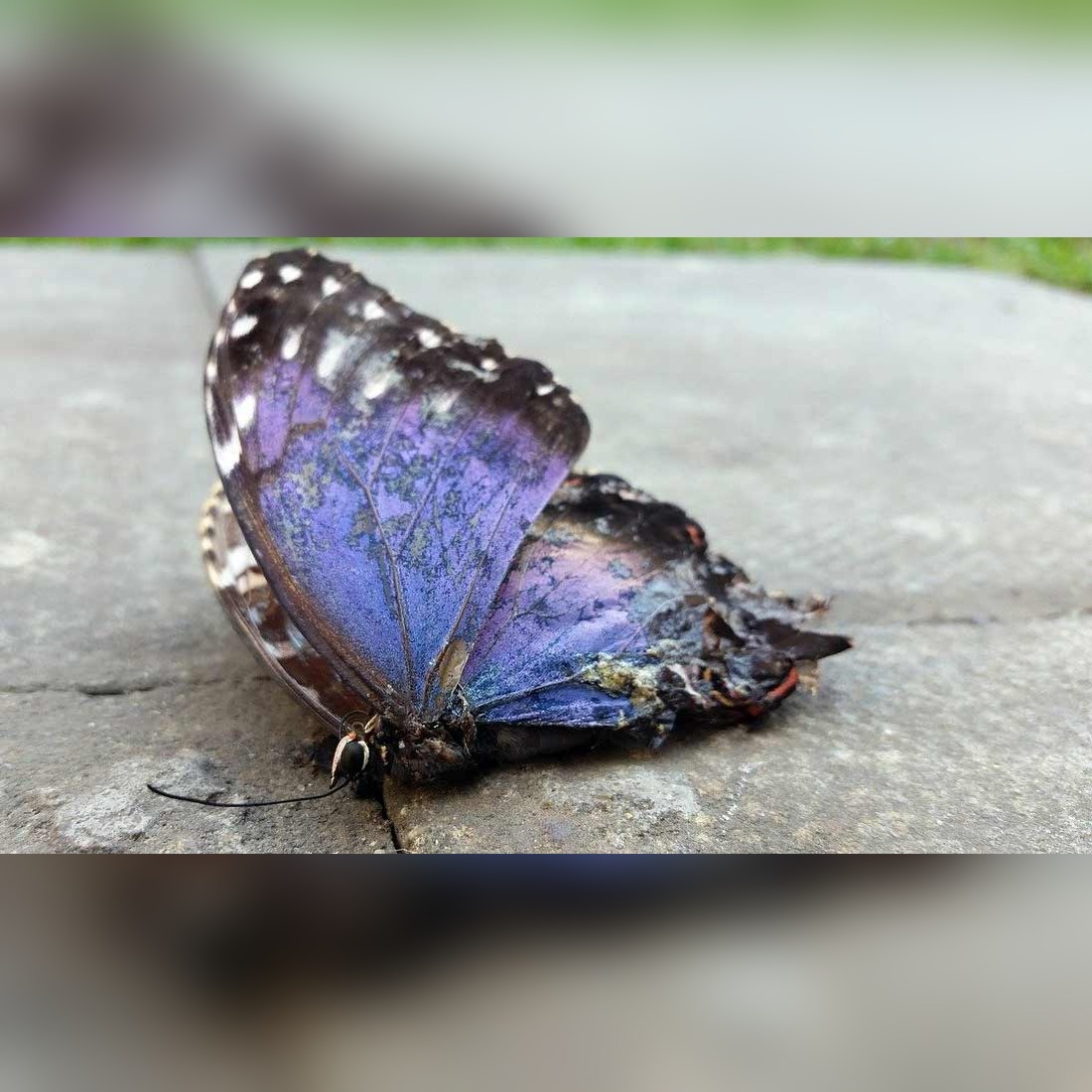
If you found a dead butterfly and looked it up immediately, you are not the first person to do that. Across five traditions I can actually trace to named sources, the dead butterfly lands closer to a threshold sign than a curse. What it means depends on where you found it, what color it was, and whether someone you loved has recently died.
Key Takeaways
- A dead butterfly most commonly signals the end of a life cycle and a passage into something new, not simple bad luck.
- Purépecha, Aztec, Greek, Japanese, and Celtic Christian traditions all independently link butterflies to the souls of the dead. This is not modern invention.
- Finding a dead butterfly after a loved one has died is read in most of these traditions as an ancestral visit or a sign of safe passage, not a warning.
- Location matters: a dead butterfly inside your home carries stronger soul-visitation significance than one found outdoors, according to Japanese folk belief and European threshold traditions.
- Color adds a layer, but no single color interpretation holds across all cultures.
What Does a Dead Butterfly Mean?
Across most of the traditions I can actually trace to named sources, a dead butterfly found in your home or yard is read as a sign of completed transformation rather than impending loss. The body is not the message—understanding butterfly broken wing symbolism and other signs of physical damage requires looking beyond surface interpretation. The timing is.
The butterfly lived its full arc: egg, larva, chrysalis, flight. The fact that you found it at the end of that arc is what the older traditions are responding to.
I want to be honest about what I don’t know here. The folk record on dead butterflies specifically (as opposed to living butterflies as soul-visitors) is thinner than the internet suggests. A lot of sites conflate the two. What I can say with confidence is that the butterfly-as-soul connection is genuinely ancient and genuinely cross-cultural, and the dead butterfly sits at the end of that symbolic line, not outside it.

The word “butterfly” goes back to Old English buttorfleoge, according to the Oxford English Dictionary, which traces the compound to butter-colored wing markings or possibly to older pastoral beliefs. Nothing in that etymology touches death. The death-connection comes from somewhere else entirely: from the Greek word psyche, which means both “soul” and “butterfly” simultaneously, and from how that double meaning spread through art, literature, and funerary practice across centuries.
You are not reading bad news into this. You are reading a very old question.
Is a Dead Butterfly a Bad Omen or a Comforting Sign?
The honest answer is that it depends on which tradition you ask, and the traditions disagree in useful ways.
Japanese folk belief, which I cover below, does sometimes read a butterfly entering domestic space as a warning that a spirit is nearby or that a death is close. That reading is real and documented. But even in that framework, the butterfly is a messenger, not a threat.

The majority of documented traditions, including Purépecha, Greek, and Celtic Christian sources, read the butterfly near death as comfort, not warning. The chrysalis becomes a tomb only so the adult can fly. That image appears in medieval grave art, in Greek funerary vases, in Mexican Día de Muertos altars, all for the same reason: it ends with flight, not with the ground.
There is no version of this that requires you to be afraid.
What Do Different Cultures Say About Butterflies and the Souls of the Dead?
Three cultures built the foundation, and they did it without any knowledge of each other.
Among the Purépecha and Mazahua peoples of Michoacán, Mexico, the annual monarch butterfly migration arrives in late October and early November, exactly when Día de Muertos is observed. Anthropologist Columba González-Duarte, whose work appears in cross-cultural documentation of monarch symbolism, has examined how Purépecha oral tradition treats the monarchs as embodied returning souls, ancestors crossing back to visit families who have laid out marigolds and candles to guide them. The monarchs arrive in the millions. The dead who return are also counted in the millions. The timing is the sign.
In Mexica (Aztec) religion, the butterfly connection to death runs through warfare and sacrifice. Bernardino de Sahagún’s Florentine Codex (c. 1577), the most detailed surviving account of Aztec religious practice, records that warriors who die in battle spend four years accompanying the sun and then return to earth as birds or butterflies. The goddess Itzpapalotl, obsidian butterfly, governs fire, sacrifice, and the souls of those who die in childbirth or combat. Butterfly swarms in this tradition mark the presence of the glorified dead.
In classical Greek thought, the case is almost embarrassingly direct. Psyche means both soul and butterfly. Apuleius’ Metamorphoses, written in the second century CE, gives his character Psyche butterfly wings after her trials, using the lexical overlap intentionally. Earlier Greek funerary art shows small winged figures leaving the mouths of the dying, figures that read as either soul or butterfly depending on how you look. Plato used the chrysalis-as-bodily-tomb image explicitly: the body holds the soul the way a pupa holds the butterfly, and death is the emergence.
Greece didn’t know about Michoacán. The Aztec calendar had no contact with Plato. And yet all three arrived at the same image: the butterfly as the soul’s shape after the body ends.
What Does Japanese Folk Belief Say About a Butterfly Appearing After Someone Dies?
Japanese folk belief on butterflies runs in two directions, and both are worth knowing.
The soul in Japanese folk religion can be called tamashii or mitama, a spirit that can take animal form and return to visit the living. Lafcadio Hearn, the Irish-Greek writer who documented Japanese folk narratives in the early twentieth century, recorded multiple vernacular accounts of butterflies as visiting souls: the spirit of a dying person appears as a butterfly near the deathbed; a butterfly in the garden after a funeral is the departed saying goodbye. In these stories the butterfly is not threatening. It is present.
But Japanese folk belief also uses the butterfly as a threshold warning. A butterfly entering a house uninvited can signal that someone in the household is close to dying, or that a spirit is seeking entry. Two butterflies together, by contrast, represent a married couple, lovers reunited after death, which is read as tender rather than ominous.
The indoor location is the variable that tips the reading. Outside the house, a butterfly near a grave or garden is almost always comforting. Inside, especially near a sick person, it carries more weight. This tracking of threshold-crossing is consistent with the European traditions below.
According to research compiled by grief and memorial specialists, the butterfly’s role as an after-death communication is one of the most widely reported spontaneous experiences among bereaved people across cultures. That doesn’t prove the supernatural. But it does suggest the symbol is doing real psychological work across centuries and traditions.
What Does Celtic and Christian Tradition Say About the Dead Butterfly?
Medieval Christian grave art is full of butterflies, and most people who visit old cemeteries walk right past them without knowing what they’re looking at.
The chrysalis-as-tomb theology is not subtle. The coffin is the pupa. The resurrection is the emergence. The butterfly is the soul freed from bodily death. This visual argument appears in Celtic funerary carving, in medieval German sermon literature, and in the illuminated manuscripts of Ireland and Britain. The butterfly didn’t need to be read into Christianity; it was already there in Greek, which the Church Fathers read fluently, and the psyche resonance carried straight over.
Celtic folk belief added the idea that butterflies carry prayers upward, acting as living messengers between the earthly and whatever is beyond it. A butterfly near a deathbed or a fresh grave was read not as a bad omen but as evidence that the soul had found its wings.
What Does a Dead Butterfly Mean When It Appears in Your Home?
According to Purépecha tradition around Día de Muertos, the monarch’s arrival inside or near the home is read as the soul crossing the threshold to visit family. The dead butterfly inside the house, in that framework, is a soul that came and rested rather than one that was turned away.
Frequently Asked Questions
Can a dead butterfly be a sign from a deceased loved one?
In Purépecha, Japanese, and Celtic Christian traditions, yes. A butterfly near or after a death is read as a soul in transit or a visiting spirit. I’m not in a position to tell you that’s literally what happened. But I can tell you the belief is genuinely old, genuinely widespread, and not something people invented to feel better. If the timing lines up with a recent loss and the encounter feels connected, that feeling has a long tradition behind it. You are not making it up.
Is it bad luck to find a dead butterfly?
Not in the traditions I can trace to named sources. The dead butterfly sits at the end of a completed life arc. Most folk traditions read completion as neutral to positive, not as a curse or an omen of harm. The one real exception is a specific reading in some Japanese folk belief where a butterfly entering a sick person’s room signals approaching death. But even there, the butterfly is a messenger, not a cause. Finding one in your garden on a September morning is an ending, not a warning. Those are different things.
What does it mean when a butterfly lands on you and then dies?
Honestly, I don’t have a confident answer drawn from documented tradition on this specific scenario. The folk record on butterflies landing on a living person and dying there is thin. What I can say: a butterfly near the end of its life seeks warmth and stillness, and landing on a human body is not unusual behavior for a dying insect. Whether the timing carries meaning is the question you’re actually asking, and I won’t pretend I can answer that with certainty. But I also won’t tell you the question is silly.
Does the species of butterfly change the meaning?
For the Purépecha tradition documented by Columba González-Duarte, yes, species matters significantly. Monarchs specifically, not butterflies in general, are the returning souls of the dead during the Día de Muertos season. In Japanese folk belief, the species is less important than the behavior, entering the home, hovering near a sick person. In Greek and Celtic Christian traditions, the symbolic work is done by the metamorphosis itself, so any species that goes through that biology qualifies. Species matters in some traditions and not in others.
What does it mean to see a dead butterfly in a dream?
Dream readings are a separate article, and I’d rather not compress them badly here. The short version: a dead butterfly in a dream reads in Jungian terms as a completed transformation, something that has changed and cannot be unchanged. It is not a death omen in most dream-symbol frameworks. The folk record on dream butterflies specifically is thinner than the waking-encounter record. If you want the longer version, I’ve written about butterfly dream symbolism separately.
Should I bury or move a dead butterfly I find?
Move it if it’s somewhere that feels wrong. Bury it if that feels right. There’s no tradition I know of that prescribes a specific ritual for a dead butterfly the way some traditions prescribe ritual for a dead bird at the doorstep. Placing it in soil, your garden, a planter, is a simple, deliberate acknowledgment. Most people find that settling. Not because it works as a spell, but because doing something small and intentional tends to help when you’re sitting with an uneasy feeling.
What does a dead white butterfly mean specifically?
In Western European folk practice, white butterflies are associated with the souls of the dead, specifically souls that have completed their passage cleanly. Irish folk belief records white butterflies near graves as signs of a peaceful death. I want to be careful here: “your loved one is at peace” as a specific promise from a white butterfly is a modern formulation, not a documented traditional one. The older belief is simpler. White marks a soul in the color of burial clothes. That reading is real. The specific reassurance layered on top of it is more recent.
Are there any traditions where a dead butterfly is considered a warning?
Yes. In some variants of Japanese folk belief, a butterfly entering domestic space near a sick or elderly person can signal that the person is close to death. This is not universal in Japanese tradition, and even where it appears, the butterfly is a messenger rather than a cause. Some European folk traditions read a black butterfly as a sign of mourning. But I’d draw a line between a warning, something bad is approaching, and a threshold sign, a passage is already underway. Most of these traditions are recording the latter.
Sources
- Lolo Mercadito, Monarch Butterflies as Spirits of Día de Muertos (Purépecha tradition overview)
- Save Our Monarchs, Cross-Cultural Symbology of the Monarch Butterfly (includes González-Duarte research context)
- Jacques Julien, Butterfly Symbolism, Myths, and Transformation (Lafcadio Hearn Japanese folk accounts)
- Yurn, Butterflies and Meaning After Death (grief and memorial research)
- Kloof Conservancy, Butterflies and Moths in Myths and Legends (cross-cultural survey)
- NOE, Papillons et Mythologie (French-language survey of butterfly mythology including Greek psyche)
- Bernardino de Sahagún, Florentine Codex (c. 1577), primary source for Aztec warrior-soul butterfly belief and Itzpapalotl
- Apuleius, Metamorphoses (c. 2nd century CE), Psyche as butterfly-soul, Greek funerary tradition
- Oxford English Dictionary, Old English etymology of “butterfly” (buttorfleoge)